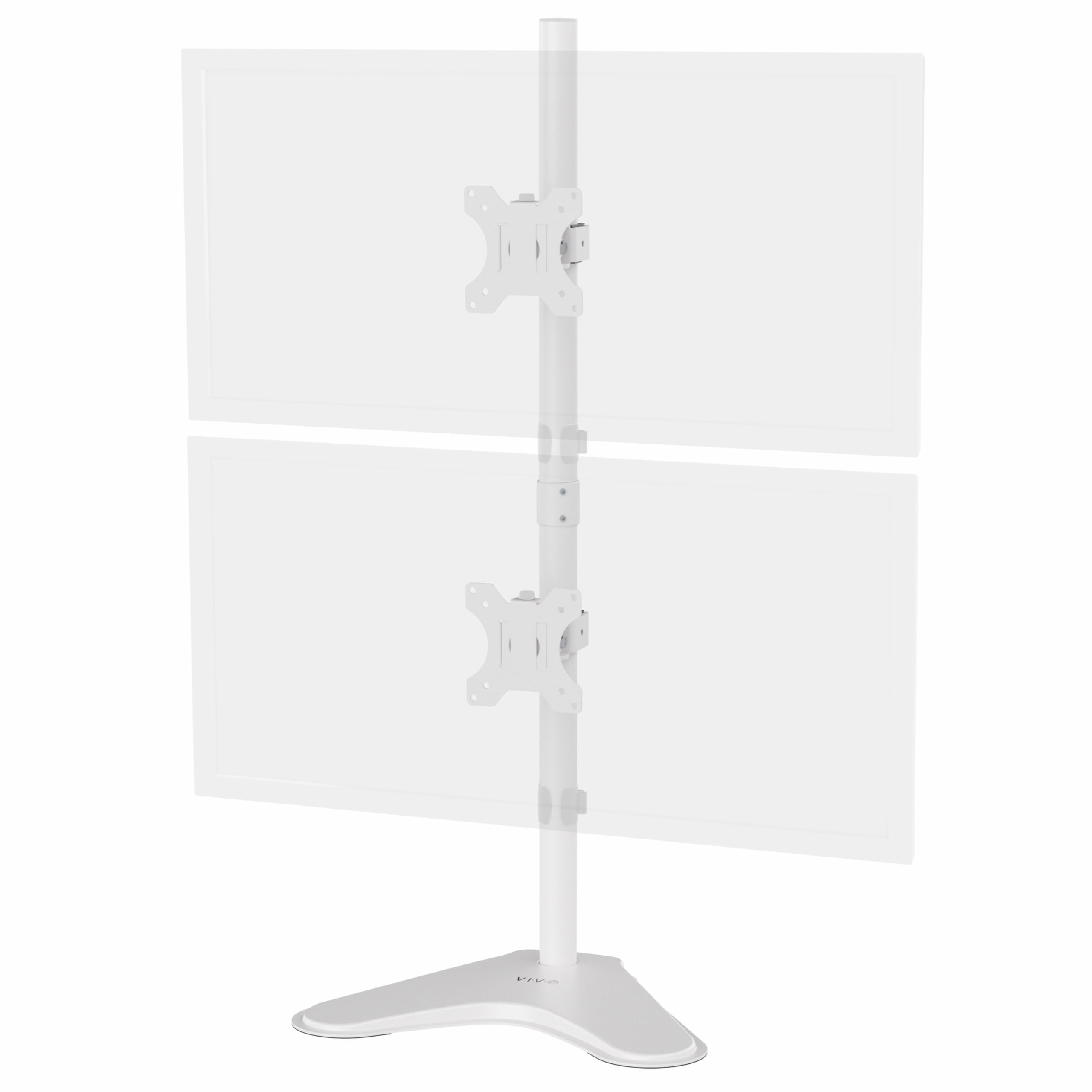
The VIVO Dual Monitor Desk Stand is a freestanding option for arranging two screens vertically, with support for monitors up to 34 inches and individual tilt, swivel, rotation, and height adjustment.
This vivo dual monitor stand review looks at the fit, desk footprint, and tradeoffs that matter before choosing a stacked display layout.
VIVO Dual Stand Review Summary
The quick verdict
3,000+ ratings
Read Amazon ReviewsVIVO Dual Monitor Desk Stand
A freestanding stacked mount for buyers pairing two VESA-compatible monitors, including ultrawides up to 34 inches, while keeping desk mounting simple.
- Freestanding tabletop base measures 15.4 by 12.4 inches and has padding underneath to help protect the desk surface.
- Holds two monitors, each 13 to 34 inches and up to 22 pounds.
- Compatible with 75-by-75mm and 100-by-100mm VESA mounting patterns.
- Adjustable brackets provide +45 to -45 degrees of tilt, 180-degree swivel, and 360-degree rotation.

Pros
- Accommodates two screens up to 34 inches and 22 pounds apiece.
- Freestanding installation can work where a desk-edge clamp is not suitable.
Consider before buying
- The two screens are arranged vertically, so it is not the right layout for buyers who want a conventional side-by-side pair.
- The 15.4-by-12.4-inch base occupies desk space and needs a stable, clear area.
Read the full review summary
The stand’s defining choice is its vertical layout: two monitors sit one above the other on a center pole and a broad desktop base, rather than extending across the desk on side-by-side arms.
That can make better use of a narrow workspace, while the 15.4-by-12.4-inch base still claims a noticeable area of the surface.
It does not require a clamp at the desk edge, so it may suit setups where a clamp mount is inconvenient.
Its 13-to-34-inch screen range and 22-pound-per-monitor capacity cover a broad set of displays, including some ultrawides. The key compatibility checks are each screen’s weight and VESA pattern: the stand uses 75-by-75mm or 100-by-100mm mounting holes.
It is a sensible fit for buyers who want two independently adjustable screens in a fixed vertical arrangement and are comfortable with a freestanding base.
The buying factors
VIVO Dual Stand Scorecard
Editorial scores reflect listed features and buyer fit; they are not laboratory measurements or customer ratings.
Screen compatibility
Supports two monitors from 13 to 34 inches, up to 22 pounds each, with standard 75-by-75mm or 100-by-100mm VESA holes.
Positioning flexibility
Each bracket offers tilt, swivel, and 360-degree rotation, with height adjustment along the center pole.
Desk setup flexibility
The freestanding base avoids a desk-edge clamp, though its 15.4-by-12.4-inch footprint needs room.
Workspace organization
The integrated cable management system is intended to keep monitor cords organized.
Installation convenience
Removable VESA plates and included hardware and instructions simplify the mounting process.
Layout versatility
Screens can rotate between portrait and landscape, but the stand is designed for a vertical stack.
Key Features and Specifications of VIVO Dual Stand
- Freestanding tabletop base measures 15.4 by 12.4 inches and has padding underneath to help protect the desk surface.
- Holds two monitors, each 13 to 34 inches and up to 22 pounds.
- Compatible with 75-by-75mm and 100-by-100mm VESA mounting patterns.
- Adjustable brackets provide +45 to -45 degrees of tilt, 180-degree swivel, and 360-degree rotation.
- Monitor height adjusts along the center pole; each screen can be oriented in portrait or landscape.
- Removable VESA plates, assembly hardware, and instructions are included; an integrated system helps organize cables.
- The stand is made with steel, aluminum, and plastic and comes with a three-year warranty.
Pros and Cons of VIVO Dual Stand
Pros
- Accommodates two screens up to 34 inches and 22 pounds apiece.
- Freestanding installation can work where a desk-edge clamp is not suitable.
- Multiple adjustment directions and portrait or landscape orientation support different viewing arrangements.
- Padded base and cable management address surface protection and cord tidiness.
- Removable VESA plates make attaching monitors more manageable during assembly.
Consider before buying
- The two screens are arranged vertically, so it is not the right layout for buyers who want a conventional side-by-side pair.
- The 15.4-by-12.4-inch base occupies desk space and needs a stable, clear area.
- Each monitor must fit the stated weight and VESA limits; check both screens before choosing the stand.
Who Should Buy VIVO Dual Stand?
Good fit
Consider the VIVO Dual Monitor Desk Stand if your desk has room for its base and you want to stack two displays without attaching a clamp to the edge.
Its capacity can accommodate monitors up to 34 inches and 22 pounds each, giving buyers more headroom than a mount limited to smaller screens. Confirm the VESA hole pattern and weight for each monitor before ordering.
The adjustment range helps tailor the angle and orientation of each screen after installation. This is useful if one display is mainly for reference material or if portrait orientation suits your reading or document work.
The three-year warranty also gives the setup a defined coverage period.
Plan the desk layout before assembly: measure the base area, consider the space above the lower monitor, and check that the stacked screens will sit comfortably in your viewing position.
The design is most compelling when vertical placement is an intentional way to fit two displays into the workspace.
Who should skip it
Skip this stand if you need two screens spread horizontally across the desk or expect to reposition them across a wide range of locations.
Its brackets articulate, but the core design is a vertical stack on a central pole.
Look elsewhere if your desk cannot spare a 15.4-by-12.4-inch base footprint, or if either monitor exceeds the supported size, weight, or VESA pattern. Verify those measurements before settling on a mount.
How the VIVO Dual Stand Fits a Two-Screen Desk
A vertical layout that saves width
Stacking monitors shifts the arrangement upward instead of placing both screens across the desk.
That can suit a narrower desk or a workflow where one screen is secondary, although the top display’s height and the base footprint should both be considered when planning the setup.
Check compatibility monitor by monitor
The 34-inch maximum is only one part of fit. Each monitor also needs to weigh no more than 22 pounds and have a 75-by-75mm or 100-by-100mm mounting pattern.
Comparing both displays against these limits is especially useful when mixing a large primary screen with a smaller secondary one.
Adjustment supports different viewing angles
Tilt, swivel, and full rotation give each bracket several ways to orient its screen, while height adjusts along the center pole.
Portrait and landscape positions can accommodate different tasks, but the fixed stacked structure remains the main layout constraint.
Freestanding mounting has a footprint
The padded base removes the need to secure the mount at a desk edge, which may simplify placement on some surfaces. In exchange, it occupies a defined patch of desktop.
Measure that area and consider the combined height of both monitors before committing to a location.
Alternatives to VIVO Dual Stand
Computer Monitor Arms alternative
60,000+ ratings
Read Amazon ReviewsVIVO Dual Ultrawide Monitor Desk Mount STAND-V038
Choose the VIVO Dual Stand when you want a freestanding vertical setup and screens no larger than 34 inches.
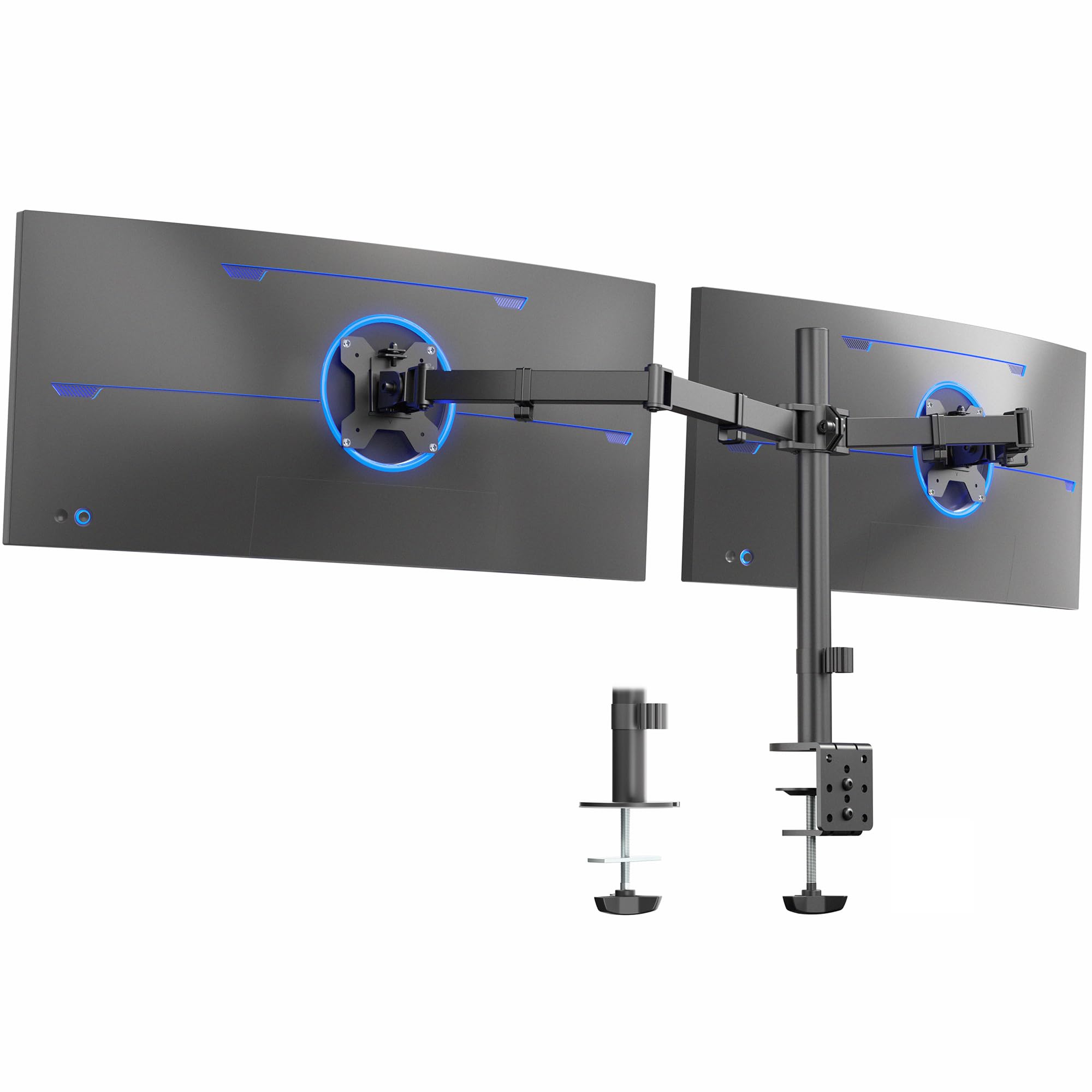
Consider the STAND-V038 if your monitors are between 34 and 38 inches or you prefer a clamp or grommet attachment; its mounting approach differs from the freestanding base.
- The VIVO STAND-V038 supports two screens up to 38 inches and 22 pounds each, with a center-pole adjustment and tilt, swivel, and rotation.
- It mounts to a desk with a C-clamp or optional grommet mount.
- The VIVO Dual Stand places monitors in a vertical stack on a freestanding base, supports screens up to 34 inches and 22 pounds each, and adjusts along a center pole.
Computer Monitor Arms alternative
5,000+ ratings
Read Amazon ReviewsHUANUO HNDS7 Dual Monitor Stand
The VIVO is the more straightforward fit for buyers committed to a freestanding vertical stack.
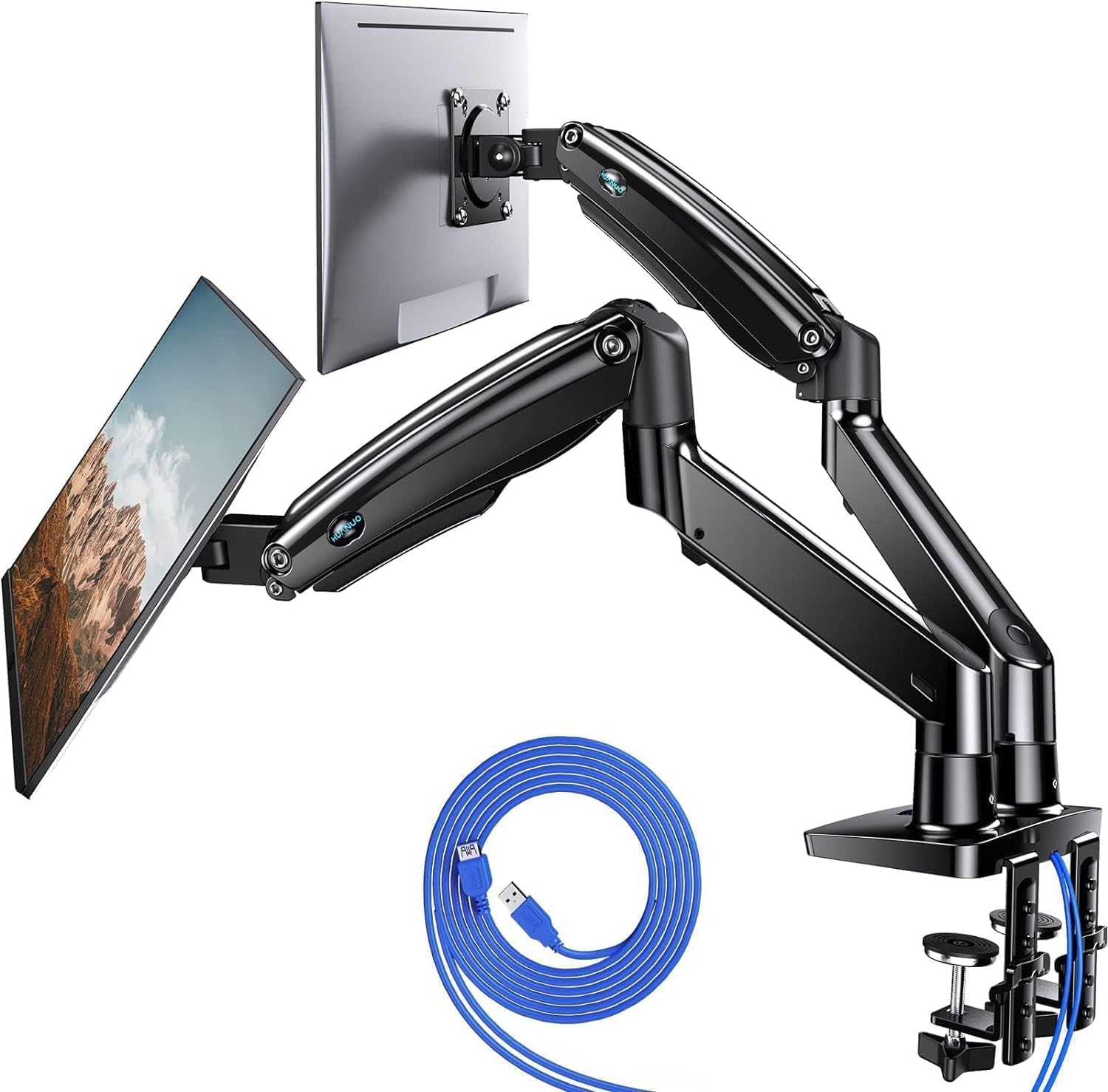
The HUANUO HNDS7 is a better match if you need support for larger or heavier displays, arm extension, desk-mounted installation, or built-in USB ports.
- The HUANUO HNDS7 supports two 13-to-40-inch monitors up to 26.4 pounds per arm.
- It offers clamp or bolt-through grommet mounting, height adjustment up to 21.1 inches, arm extension up to 25.59 inches, and two built-in USB ports.
- The VIVO Dual Stand is a vertical stack on a freestanding base and supports two monitors up to 34 inches and 22 pounds each.
Is VIVO Dual Stand Worth It?
The VIVO Dual Monitor Desk Stand is worth considering if your priority is a tidy vertical pair of screens, your monitors meet its VESA and weight limits, and you have space for the freestanding base.
Its screen capacity and adjustment options make it adaptable to a range of two-monitor setups.
Before buying, measure the desktop area and check both monitor specifications. Choose another style if you need a side-by-side arrangement or greater placement flexibility; this stand’s value depends on wanting a vertical stack.
Your review at a glance
3,000+ ratings
Read Amazon ReviewsVIVO Dual Monitor Desk Stand
A freestanding stacked mount for buyers pairing two VESA-compatible monitors, including ultrawides up to 34 inches, while keeping desk mounting simple.
- Freestanding tabletop base measures 15.4 by 12.4 inches and has padding underneath to help protect the desk surface.
- Holds two monitors, each 13 to 34 inches and up to 22 pounds.
- Compatible with 75-by-75mm and 100-by-100mm VESA mounting patterns.
- Adjustable brackets provide +45 to -45 degrees of tilt, 180-degree swivel, and 360-degree rotation.